

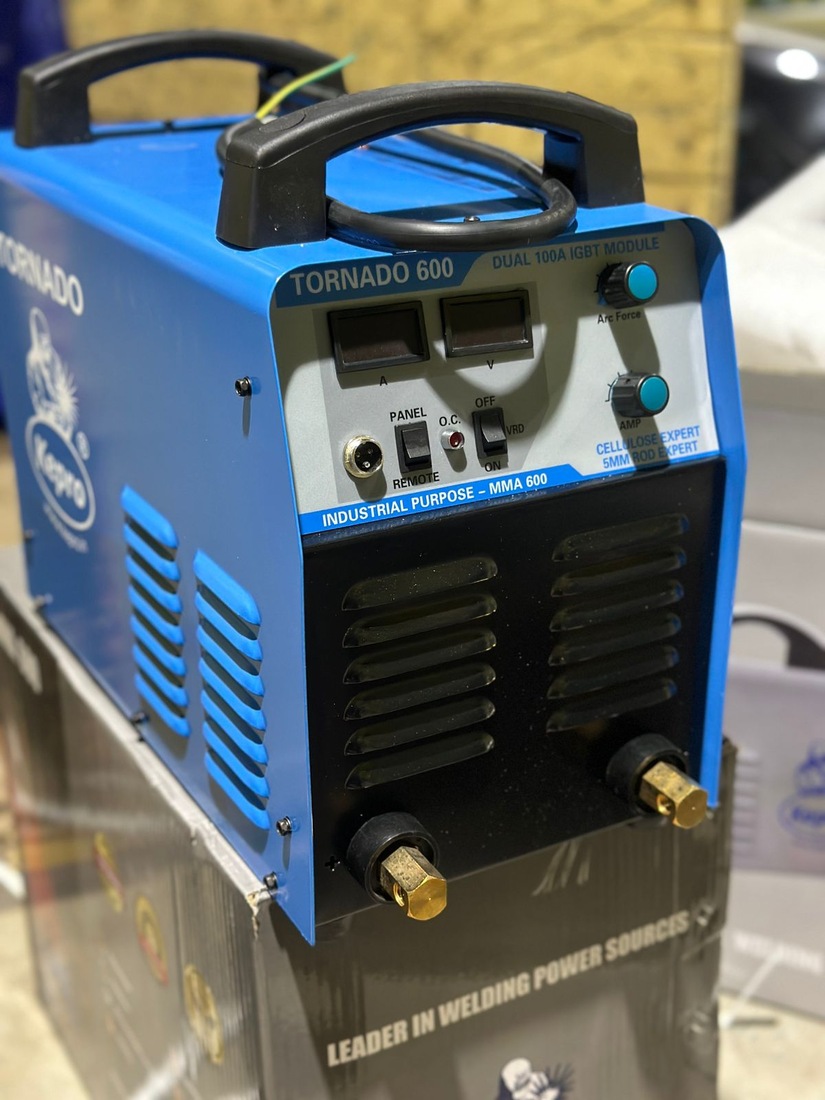
Choosing the right welding machine can make a significant difference to the quality of your work, productivity, and overall operating costs. Whether you run a fabrication workshop, manufacture industrial equipment, or carry out metal repair work, selecting the right welding process is essential.
Three commonly used welding processes are MIG, TIG, and MMA welding. Each has its own working method, advantages, limitations, and applications. While MIG welding is often preferred for faster production, TIG welding is known for its precision and clean welds. MMA welding, also called stick welding, is valued for its versatility and suitability for many outdoor and maintenance jobs.
But which welding machine is right for your business?
In this guide, we will compare MIG vs. TIG vs. MMA welding machines, explain how each process works, and discuss the factors you should consider before purchasing industrial welding equipment.
What Is MIG Welding?
MIG stands for Metal Inert Gas welding. The process is commonly referred to as Gas Metal Arc Welding (GMAW).
In MIG welding, an electric arc forms between a continuously fed wire electrode and the workpiece. The wire melts to create the weld, while shielding gas protects the molten weld pool from atmospheric contamination. The wire also acts as filler material.
Depending on the material and application, different shielding gases and wire types may be required.
Advantages of MIG Welding
- High productivity: Continuous wire feeding reduces the need to stop frequently to replace electrodes, making MIG welding suitable for many production environments.
- Relatively easy to learn: With proper training and suitable machine settings, operators can develop consistent welding techniques.
- Suitable for repetitive work: MIG welding is commonly used in fabrication shops and manufacturing facilities where multiple similar components need to be welded.
- Versatile applications: Depending on the machine, wire, gas, and process settings, MIG welding can be used on various metals and thicknesses.
Common Applications of MIG Welding
MIG welding is widely used in:
- Automotive manufacturing and repair.
- Sheet metal fabrication.
- Industrial equipment manufacturing.
- Structural fabrication.
- Metal furniture production.
- General manufacturing and assembly.
When Should You Choose a MIG Welding Machine?
A MIG welding machine may be the right choice when your work involves repetitive welding, production efficiency, and relatively high welding speeds.
However, the process generally requires a wire-feeding system and, for conventional gas-shielded MIG welding, an appropriate shielding gas supply. Wind can disturb the shielding gas, so outdoor work may require a different welding process or suitable protection.
What Is TIG Welding?
TIG stands for Tungsten Inert Gas welding. It is also known as Gas Tungsten Arc Welding (GTAW).
TIG welding uses a non-consumable tungsten electrode to produce the arc. Shielding gas, usually argon or an appropriate gas mixture, protects the weld area. Filler metal can be added separately when required.
Unlike MIG welding, the electrode does not serve as the filler material. This allows the operator to control heat input and filler addition independently.
TIG welding requires greater operator skill, but it can produce precise, clean welds when the material, equipment, and technique are appropriate.
Advantages of TIG Welding
- Precise control: The operator can control the arc and filler addition, which is useful for detailed welding work.
- Clean weld appearance: TIG welding can produce neat welds with minimal spatter when performed correctly.
- Suitable for thin materials: With the correct equipment and technique, TIG welding can be effective on thin metal sections that require careful heat control.
- Broad material applications: TIG welding is used on materials such as stainless steel, aluminium, and carbon steel, subject to suitable equipment and procedures.
Common Applications of TIG Welding
TIG welding is commonly used for:
- Stainless steel fabrication.
- Aluminium components.
- Precision engineering.
- Food processing equipment.
- Thin metal sections.
- Applications where weld appearance and control are important.
When Should You Choose a TIG Welding Machine?
Consider a TIG welding machine when precision, weld appearance, and control over the welding process are priorities.
It can be particularly useful for detailed fabrication and applications where visible weld quality matters.
The main considerations are the operator's skill level, welding speed, material thickness, and equipment cost. TIG welding is often slower than MIG welding for comparable production tasks.
What Is MMA Welding?
MMA stands for Manual Metal Arc welding. It is also known as Shielded Metal Arc Welding (SMAW) or stick welding.
MMA welding uses a consumable, flux-coated electrode to produce the welding arc. As the electrode melts, it provides filler metal, while the flux creates shielding gases and slag that protect the weld during solidification.
Unlike conventional MIG and TIG welding, MMA welding does not require an external shielding gas supply.
This makes it a practical option for many maintenance, repair, construction, and outdoor welding tasks.
Advantages of MMA Welding
- Portable equipment options: Many MMA welding machines are compact and easy to transport between job sites.
- No external shielding gas required: This simplifies equipment setup and can be advantageous for outdoor work.
- Suitable for repair work: MMA welding is commonly used for repairing metal structures, equipment, and machinery.
- Useful in varied environments: The process can be suitable for outdoor and field applications when the conditions, consumables, and welding procedure are appropriate.
Common Applications of MMA Welding
MMA welding is commonly used in:
- Construction and structural repair.
- Industrial maintenance.
- Pipeline-related work where the approved procedure permits it.
- Agricultural machinery repair.
- Outdoor fabrication.
- General metal repair.
When Should You Choose an MMA Welding Machine?
An MMA welding machine is worth considering if your work involves field repairs, maintenance, construction, or locations where carrying shielding gas is inconvenient.
However, electrode selection, slag removal, operator technique, and the need to replace consumed electrodes should be considered when estimating productivity.
MIG vs. TIG vs. MMA Welding Machines: Key Differences
The best welding process depends on the material, required weld quality, production speed, working environment, and operator skill.
| Comparison factor | MIG welding | TIG welding | MMA welding |
|---|---|---|---|
| Full form | Metal Inert Gas | Tungsten Inert Gas | Manual Metal Arc |
| Electrode | Continuously fed consumable wire | Non-consumable tungsten electrode | Consumable flux-coated electrode |
| Filler material | Usually supplied through the wire | Separate filler rod when required | Supplied by the electrode |
| Shielding | Usually external shielding gas | Usually external shielding gas | Flux coating provides shielding |
| Welding speed | Generally high for suitable production tasks | Generally slower | Depends on the task and operator |
| Weld appearance | Good with correct settings and technique | Often excellent with proper technique | Can require slag removal and finishing |
| Operator skill | Moderate, depending on application | Often requires greater skill | Requires suitable electrode and arc-control skills |
| Outdoor suitability | Shielding gas can be affected by wind | Shielding gas can be affected by wind | Often suitable for outdoor work in appropriate conditions |
| Common applications | Production and fabrication | Precision and high-quality fabrication | Maintenance, repair, and construction |
These are general comparisons. Actual performance depends on the welding machine, consumables, material, joint design, welding position, and operating procedure.
Which Welding Machine Is Best for Your Business?
There is no single welding machine that is best for every industrial application. The right choice depends on what you weld, how often you weld it, and the quality and productivity requirements of your work.
Choose MIG Welding for Production Efficiency
If your business handles repetitive fabrication, metal furniture, automotive components, or general manufacturing, MIG welding may offer the productivity you need.
Its continuous wire-feed system can reduce interruptions and help maintain consistent output when the process is properly set up.
Choose TIG Welding for Precision
If your work involves thin materials, stainless steel components, aluminium fabrication, or applications where appearance and precise heat control are important, TIG welding may be the better option.
It is particularly useful when the quality of the finished weld is more important than maximum welding speed.
Choose MMA Welding for Maintenance and Outdoor Work
If your team performs repairs at construction sites, maintains machinery, or works in locations where portability is important, MMA welding may be a practical choice.
Its simpler equipment arrangement and lack of an external shielding gas requirement make it useful for many field applications.
Factors to Consider Before Buying a Welding Machine
Before purchasing a welding machine, consider the following points.
1. Type of Material
Identify whether you will be welding mild steel, stainless steel, aluminium, or another metal. Not every machine or process is suitable for every material without the correct configuration and consumables.
2. Material Thickness
Thin sheet metal and thick structural components may require different processes, current ranges, and welding procedures.
Check the manufacturer's specifications to ensure that the machine can handle your intended applications.
3. Welding Frequency
A workshop carrying out occasional repairs may have different requirements from a manufacturing unit operating multiple shifts.
Consider the machine's rated duty cycle, expected operating hours, and production requirements.
4. Power Supply
Check the available electrical supply, voltage requirements, phase configuration, and the machine's rated input current.
Choosing equipment compatible with the facility's electrical infrastructure can help avoid installation problems.
5. Portability and Working Conditions
For stationary fabrication, a larger machine may be appropriate. For maintenance teams working across different locations, a compact, portable machine may be more convenient.
Also consider ventilation, environmental conditions, and the need for appropriate protection from weather.
6. Consumables and Maintenance
Compare the ongoing costs of wire, electrodes, shielding gas, tungsten electrodes, filler rods, and other consumables relevant to the selected process.
Consider spare parts availability, servicing requirements, warranty coverage, and access to technical support.
7. Total Cost of Ownership
The lowest purchase price does not always result in the lowest operating cost.
Consider productivity, consumables, electricity use, maintenance, finishing requirements, operator training, and downtime when comparing machines.
Frequently Asked Questions
1. Which is better: MIG, TIG, or MMA welding?
The best option depends on the application. MIG welding is often preferred for production efficiency, TIG welding for precision, and MMA welding for many maintenance and outdoor tasks.
2. Is TIG welding stronger than MIG welding?
Not automatically. Weld strength depends on the base material, joint design, welding procedure, filler material, and quality of execution. A properly produced MIG or TIG weld can meet the required strength when the process is suitable for the application.
3. Which welding machine is suitable for beginners?
MIG welding is often considered approachable for beginners in controlled workshop environments. MMA welding can also be learned with training, while TIG welding generally requires more coordination and practice. All welding processes require appropriate training and safety precautions.
4. Can MMA welding be used outdoors?
Yes, MMA welding is commonly used outdoors because it does not rely on an external shielding gas supply. However, operators must follow appropriate welding procedures and safety requirements for the working environment.
5. Which welding machine is best for stainless steel?
MIG, TIG, and MMA processes can all be used for suitable stainless steel applications with the correct equipment and consumables. TIG is often selected for precision and appearance, while MIG may be preferred for productivity. The choice depends on material thickness, production requirements, and the required weld quality.
Conclusion
MIG, TIG, and MMA welding machines serve different purposes, and understanding their differences can help you make a more informed purchasing decision.
MIG welding is often suitable for production work where speed and consistency matter. TIG welding offers greater control for precision applications, while MMA welding is a practical option for many maintenance, repair, and outdoor jobs.
Before choosing a welding machine, evaluate the materials you work with, material thickness, production requirements, available power supply, consumable costs, and maintenance needs.
Looking for industrial welding equipment? Explore the welding machine range available from KEPRO India and compare the specifications to find equipment suitable for your workshop or industrial application.
Need help choosing the right equipment?
Share your load, lifting height and application details with the KEPRO TOOLS team and get guidance on a suitable configuration.
Request a Quote